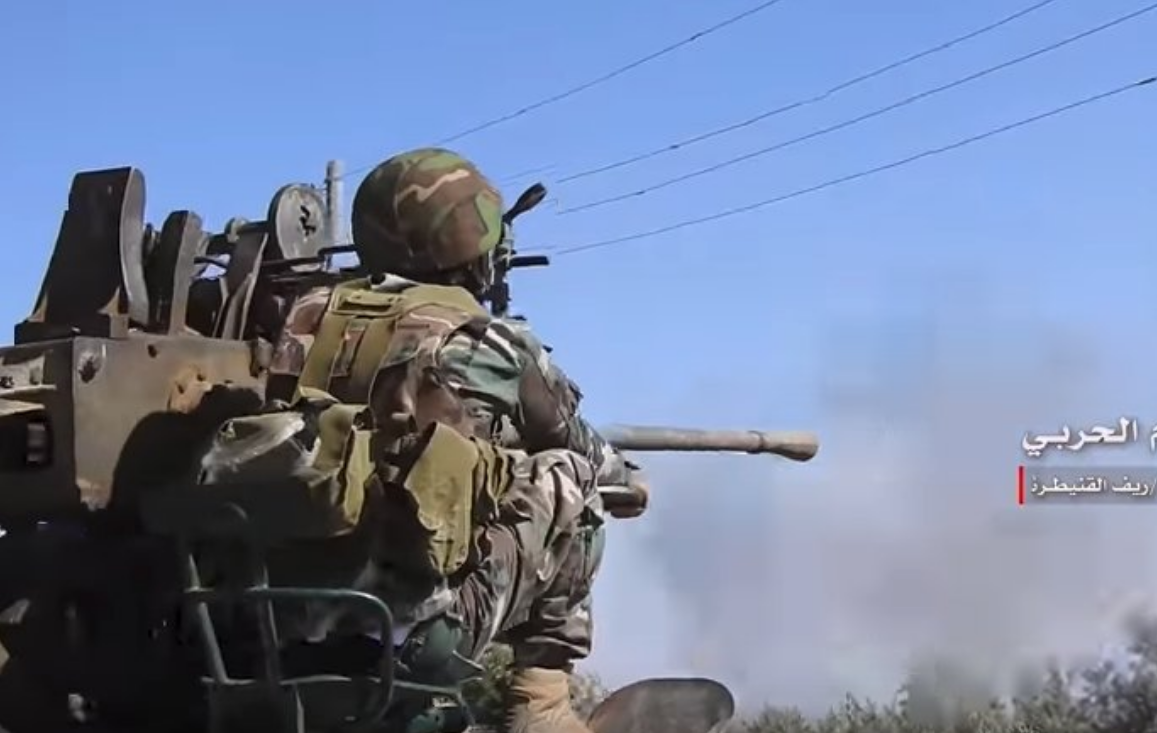
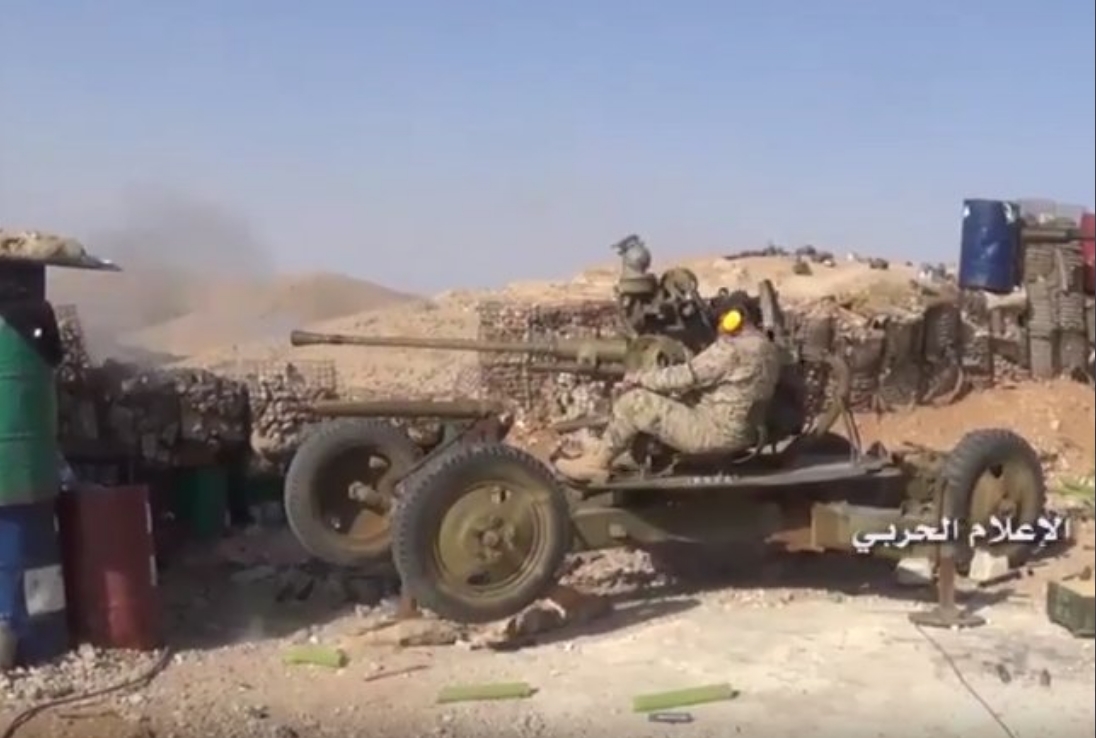
ISIS first became a significant player in the Syrian Civil war in 2013. It was allied to rebel factions mostly in the North of Syria, like Idlib and Aleppo provinces. Political pundits that are against the Syrian Government often allege that the SAA (Syrian Arab Army) never fought ISIS, or worse even cooperated with them. This article will show photographic proof the the Syrian army fought ISIS, and in fact was the first group on earth to do so (at least the current form of ISIS.)
An example of top tier propaganda. Many people in the West fall for this blatant propaganda because they don't do their own research, and that's what the authors count on.

A Misinformed politician.

August 4th, 2013. The FSA and ISIS begin the "Operation to Liberate the Coast" offensive in the Province of Latakia. Latakia is home to a large percentage of Alawites, the sect shared by president Bashar Assad. Alawites are seen as infidels to the rebels, who are entirely Sunni. The rebel offensive launched from their stronghold of Salma, with several villages quickly being captured using combined tactics of extremists and moderates. Suicide bombers and anti-tank missiles led to a quick advance. The Alawite population largely managed to flee the rebel/ISIS offensive, but a few hundred were captured or executed. Some of these hostages continued to be held by the FSA until their release in early 2017.
ISIS planning the 2013 Latakia offensive.

A T-55 advances. Filmed by ISIS media.

ISIS either executing civilians or in battle with the Syrian army.

ISIS with captured Alawite civilians after the conclusion of the battle.

The battle of Minnagh Airbase began on the 2nd of August, 2012. The airbase was put under siege by the FSA for about a year, with the rebels trying to break into it several times without success. The airbase was only captured after ISIS joined the battle alongside the other rebel groups in August of 2013. ISIS used VBIEDs (Vehicle Borne Improvised Explosive Device) to destroy the gates of the base and break the Syrian Government's defensive positions. After the chaos of the explosion the surviving Government forces inside the airbase retreated and made it to Kurdish lines near the city of Afrin. The Free Syrian Army, alongside ISIS, then declared Minnagh Airbase "liberated."
Before ISIS joined the battle the FSA shelled Minnagh Airbase with various weapons. They tried several times to advance inside the airbase with no success, the most they could manage to do was to harass the defenders inside the base. ISIS was the key factor.
The VBIED preparing to ram the airbase.

The VBIED detonates, scattering the defenders. Filmed by the ISIS media network Al-Hayat.

ISIS shells the base with an M-46 130mm.

An ISIS fighter with an RPG-29.

ISIS fighters duck as the SAA shells them with artillery or an RPG round, it's unclear.

ISIS inside the airbase.

FSA leader colonel Okaidi with ISIS fighters in the airbase.

September 11-12, 2013. ISIS and Harakat Nour al-Din al-Zenki (an FSA affiliated group) launch an offensive to capture the Brigade 66 Army Base in Northern Hama. Zenki attacked targets within the base using anti-tank guided missiles and tanks, while ISIS stormed the base with armored vehicles and infantry.
An ISIS leader, Omar Shishani on a T-72AV in the base.

ISIS raises their flag.

A captured T-62 in brigade 66.

The Battle of Raqqa began on March 3rd 2013. It was launched against the Syrian Arab Army (SAA) by rebels made up of the Free Syrian Army, Ahrar Al-Sham, Jabhat Al-Nusra and ISIS.
The Battle of Raqqa lasted only a few days, from March 3rd to March 6th. Most of the city was under rebel control by March 5th. By March 5th the SAA controlled only a few security buildings in the Western side of the city. The remaining SAA held buildings were captured the following day on March 6th, leaving the entire city under rebel control. The SAA was now besieged in the Division 17 base to the North of Raqqa. The SAA had been taken by surprise by the rebel offensive, falsely believing that the rebels would not attempt to take the city.
Rebel numbers during the offensive measured several thousand fighters, while just 400 SAA defended the city. Jabhat Al-Nusra made up the bulk of the offensive, followed by Ahrar Al-Sham and the Free Syrian Army. ISIS also participated in the battle, though at a smaller scale.
ISIS with a crashed Syrian air force MiG-21 that didn't recover from a dive while bombing ISIS in Raqqa.

ISIS executes SAA soldiers in retaliation for airstrikes.


While ISIS governed the city of Raqqa with an iron fist, other rebel groups attacked the last SAA outposts in the region, the Division 17 base and Brigade 93 base. Being besieged, they relied on Mi-8/17 helicopters to airdrop supplies. Division 17 would only fall after ISIS reentered the fight in July of 2014. ISIS lost 28 fighters taking Division 17.
Syrian air force drops to Division 17 near Raqqa city.


ISIS used VBIEDs to take Brigade 93.


Many tanks were captured from Brigade 93 from the SAA who were overwhelmed by the suicide bombers. Mostly T-55s.


After Raqqa countryside was secured by ISIS they pushed on to Tabqa in 2014. Tabqa hosted a military airbase that was used by the SyAAF to hit Raqqa. At first the Syrian Army was able to fight them off.
Dead ISIS outside Tabqa Airbase.

A Failed VBIED.


Things changed in August 2014, the airbase was overrun after a night time assault.
Captured MiG-21s in Tabqa. All airworthy examples were flow out, leaving derelict examples behind.


Captured Syrian soldiers were executed in Tabqa.


Kweres airbase was unbreakable. It had been besieged for years East of Syria's largest city, Aleppo. Its defenders never waivered and the siege of the base was eventually broken in December 2015.
Dead ISIS inside kweres.

Captured ISIS vehicles that attempted to storm the airbase. A BMP-1, T-72 and T-55.


An ISIS ZU-23-2 trying to hit jets taking off from Kweres with no luck.

In May of 2015, ISIS captured the ancient city of Palmyra in central Syria from the SAA.
Captured weapons in Palmyra, M-46 130mm.

A destroyed Mi-8/17 with ISIS's flag.

ISIS destroys the Palmyra prison.

The first battle of Qaryatayn in Homs province would see the town captured by ISIS. They were encroaching on Damascus countryside.
A D-30 fires on the SAA in Qaryatayn.

An HJ-8 ATGM launches at the SAA in Qaryatayn.

A SyAAF Su-22 confronting ISIS.

ISIS trying to shoot the jet down with a ZU-23-2.

A Captured ZSU-23-4 Shilka and dead SAA soldiers killed in combat for Qaryatayn.


Mahin was captured by ISIS after Qaratayn, but the SAA launched a counteroffensive and retook the small town.


SAA T-72B inside recaptured Mahin.

-----2016-----
An offensive was launched by the SAA the clear the area around Kweres airbase in early 2016. The base had just been freed of a years long siege and the SAA didn't want it to be besieged yet again.
An ISIS T-72AV fires on SAA as they advance around Kweres Airbase.


ISIS fires a MILAN ATGM at an SAA tank near Kweres.

ISIS used a large number of TOW ATGMs around Kweres. These were originally supplied by the US to the FSA.


Intense battles happened in and around Deir Ezzor city in 2016. ISIS fully besieged Deir Ezzor in 2015. The city became a kind of Stalingrad between the SAA and ISIS.
ISIS fires a Fagot ATGM at the SAA in Deir Ezzor.
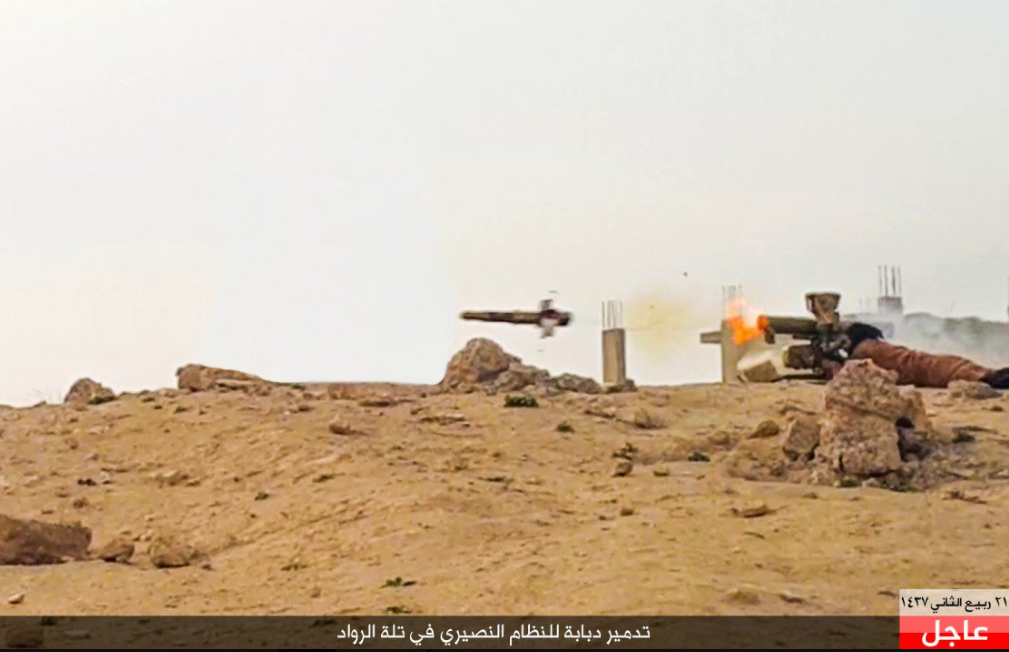
A T-72 Ural fires on SAA in urban combat.

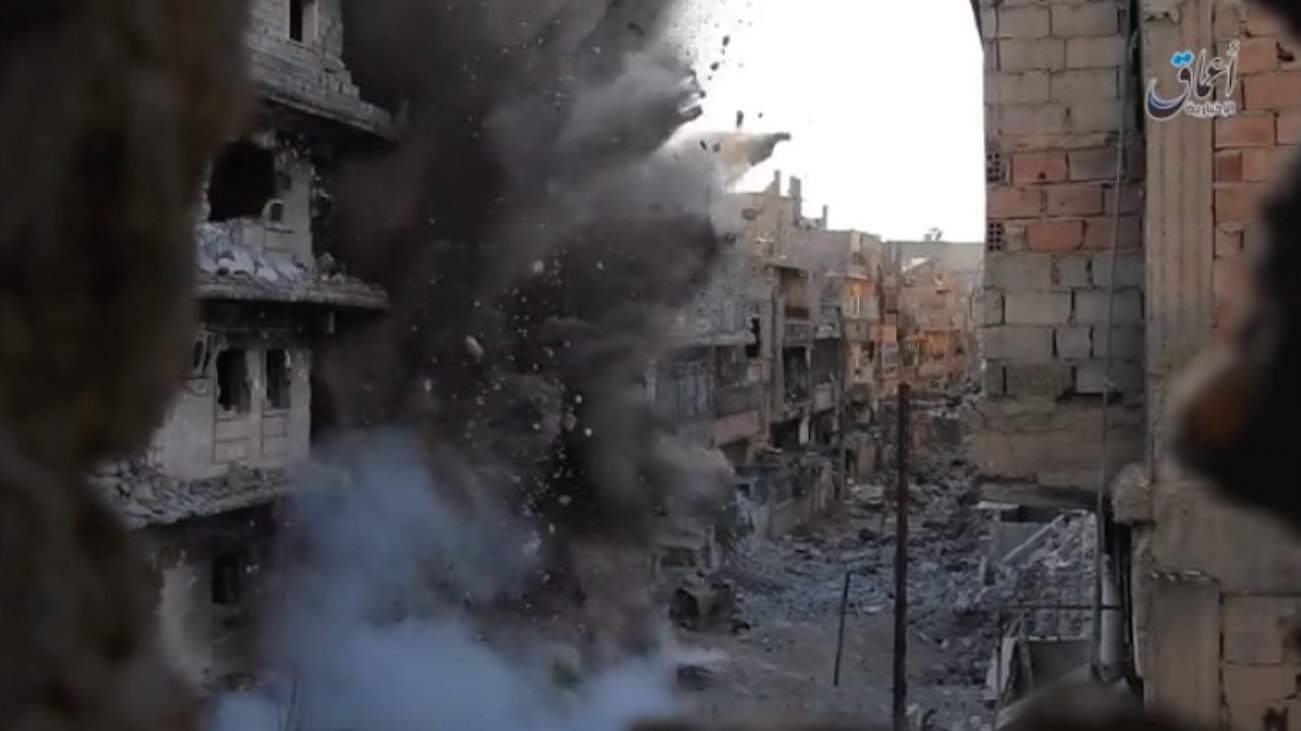
A tunnel bomb detonates in Deir Ezzor city.
A truck with a BMP-1 turret fires.


A MiG crashed while bombing ISIS around Deir Ezzor. The pilot's body was put on display in the ISIS controlled city center.


A failed VBIED seen by SAA media in Deir Ezzor.

Major Homs Province battles would take place in 2016. This map features December, after the SAA recaptured Palmyra. However, Plamyra would be briefly lost again only to be recaptured.

The battle for Huwaysis, a small town in Homs was quite a large battle that even brought in the Russian Air Force. The town was heavily fought for and captured by ISIS in late 2016.
A Russian Mi-28 seen from ISIS's perspective.

A Russian Mi-35 destroyed on the ground by an ATGM (anti-tank guided missile) near Huwaysis.

ISIS fires a ZU-23-2 on Huwaysis.

A W85 heavy machine gun.

An HJ-8 fires on a target in Huwaysis. These were originally supplied by the West to "moderate rebels."

ISIS began to harass Tiyas (T4) Airbase in Homs province around December of 2016. Tiyas is Syria's largest Airbase.
ISIS fires an S-60 57mm at SAA positions near Tiyas Airbase.


SAA returns fire near Tiyas with a T-62.

A ZSU-23-4 Shilka fires near Tiyas.


ISIS harassed another SyAAF airbase in February 2017. Sayqal (al-Seen) Airbase is also located in Homs province. It is home to Syria's fleet of MiG-29s, their most advanced fighter jet.
An ISIS T-55 moving on Sayqal.

Firing on Sayqal.

ISIS fighters and T-72M1 prepare for battle.

A jet takes off to confront ISIS.

An ISIS ZPU-2 fires at the jet as it takes off.

A Burning 2S1 Gvozdika and dead SAA soldiers near the base. Even though ISIS put up a heavy fight, they would not capture Sayqal Airbase.


----2017----
2017 was the year ISIS's momentum would finally run out. By the end of 2017 they would have just pockets left in Homs, Damascus, Suwayda, Hama and Daraa provinces.
An Eastern Aleppo operation was launched by the SAA in early 2017. The SAA encountered stiff resistance from ISIS, with ISIS using some of their most advanced tank modifications, indicative of how important the Aleppo countryside was for them. ISIS would be pushed out of Aleppo province and the SAA would enter Raqqa province from the North.
East Aleppo map at the start of the offensive.


An ISIS T-55 fires on the advancing SAA.

A heavily modified T-72.


An ISIS drone drops a bomb on the engine of an SAA T-72 in Eastern Aleppo.


"The workshop" as it came to be known upgraded dozens of tanks over its short career. Many different tank modifications were designed by ISIS including some with different ERA configurations and spaced armor. ISIS even experimented with built on canopies to hide from the Coalition, Russian and Syrian air forces. The Syrian army dealt the death blow to ISIS's tank fleet with the capture of "The Workshop."
T-55 tanks captured in the workshop.

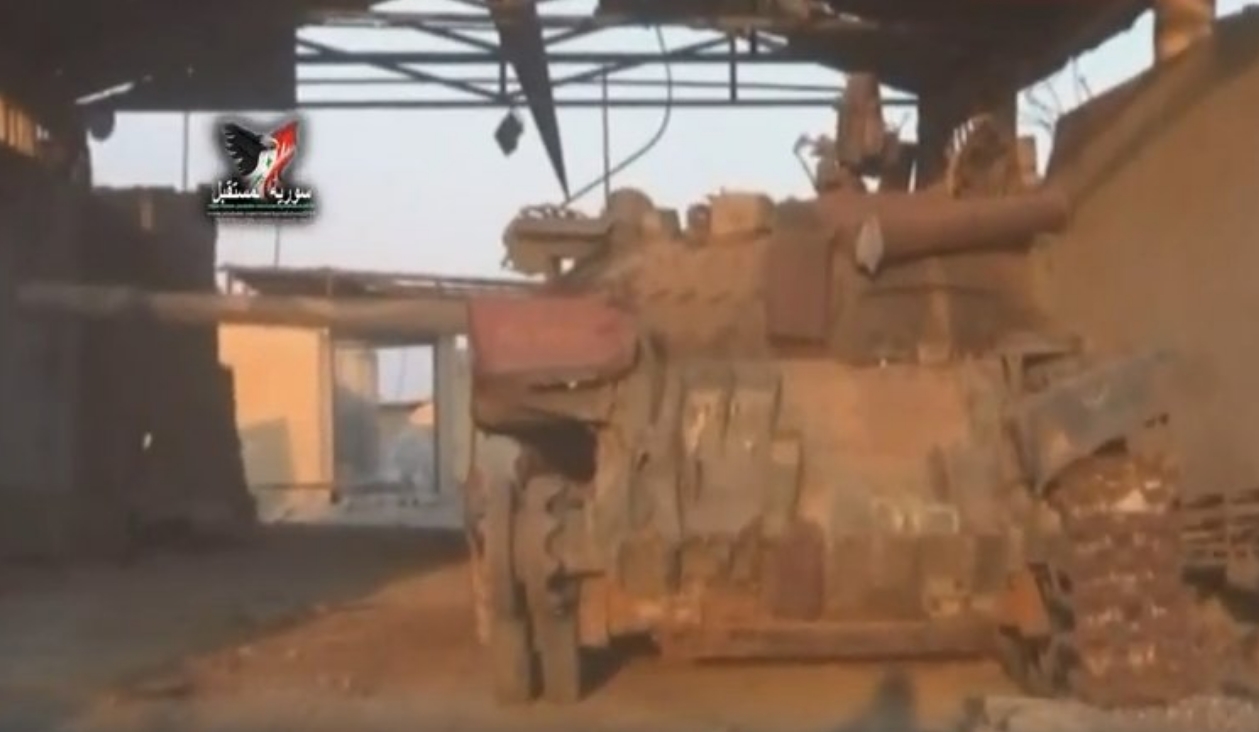


An SAA soldier inside the armor workshop.


Fighting near the city of Sukhnah in Homs province as the Syrian army advanced toward Deir Ezzor city. Sukhnah was the midway point between Palmyra and Deir Ezzor.
An SAA T-55 fires on ISIS East of Palmyra.

An advancing SAA T-62M hit by ISIS ATGM near Sukhnah.

A D-30 tries to slow the SAA.

A T-55 fires on the SAA.

A ZU-23.


Map after the SAA took control of Sukhnah.

As the Syrian army approached Deir Ezzor city and airbase, ISIS threw in some of their last tanks to counter the SAA's momentum, and fought the SAA garrison in the city.
ISIS fires a Konkurs ATGM in Deir Ezzor.

A modified T-55 fires on the SAA.


A modified T-72 captured by the SAA as they approached Deir Ezzor.

A modified T-55 captured by the SAA, Deir Ezzor.


A Map of Deir Ezzor before the siege was broken by the SAA.

ISIS continued to fight near Deir Ezzor to the South. A modified T-72.


The SAA approaches the last stronghold of ISIS in Syria, the town of Bukamal on the Euphrates river and Iraqi border.
ISIS launches a Fagot ATGM in Bukamal.


A BMP-1 deploys ISIS fighters in Bukamal, possibly their only remaining BMP-1.


A Map of Syria after Bukamal was captured by the SAA. Now only open desert remained under ISIS control in the East of the country.

After these advances a pocket of ISIS resistance was left in Eastern Hama countryside.
Eastern Hama map.


----2018----
Only pockets of ISIS resistance remained in 2018. The pockets were systematically destroyed by the SAA. Only ISIS sleeper cells would remain in the country after 2018.
Yarmouk refugee camp was ISIS's last stronghold in the Damascus Province. It is located in Southern Damascus city.

Possibly ISIS's last T-72 in use in Yarmouk camp.

A DShK technical in Yarmouk.

An abandoned SAA BMP-1 in Yarmouk. It's passengers were killed.

ISIS made armored troop carriers in Yarmouk camp.

A Destroyed SAA T-72 "Shafrah" armored tank in Yarmouk.

A destroyed SAA T-72 TURMS-T in Yarmouk. Tanks are not built for urban combat.

A ZSU-23-4 Shilka filmed in Yarmouk camp.

SAA celebrate near an ISIS position in Yarmouk camp with a T-62M.

The Safa volcanic area in Suwayda province is a Mars-like landscape that some of the last ISIS fighters hid out in in 2018.
Firing an Konkurs ATGM on SAA advancing in Safa.


Firing a Sayyad-2 anti-material rifle on the SAA in Safa.

The battle for Yarmouk Basin in Daraa province would see ISIS's territory eliminated.
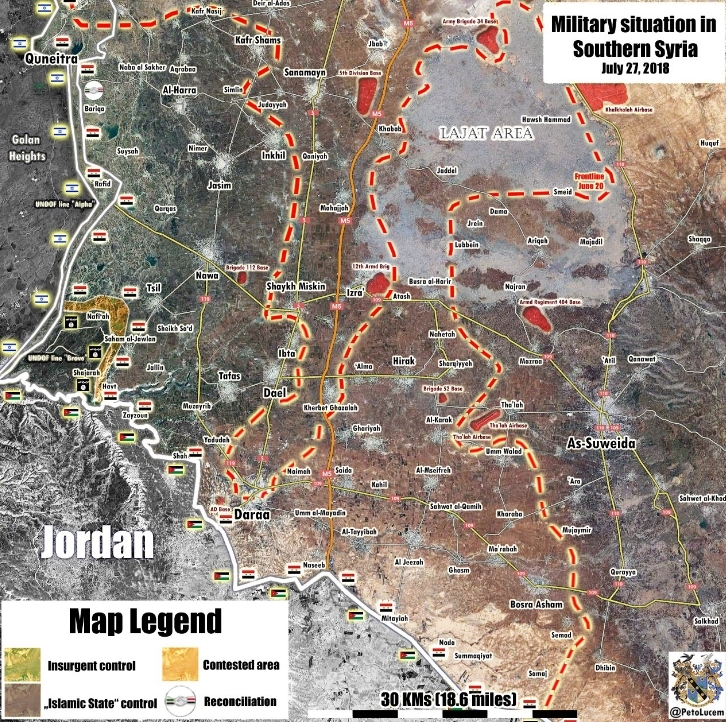

An SU-22 shot down by Israel as it was striking ISIS targets in Yarmouk basin. Filmed by ISIS media.


A captured ISIS AMB-S in Yarmouk Basin.

A map of Syria, cleansed of black.

What many pundits and media men have said about Syria, Assad and the SAA have largely been lies. The best example of this and the biggest lie of all is that Syria's Army did not fight ISIS.